Ranked Robin:
In a Round Robin tournament, each contestant faces off against each other contestant and if you win your matches you win the tournament. This is essentially how Ranked Robin works, but using ranked ballots, the whole tournament can happen all at once. The candidate preferred over all others wins.
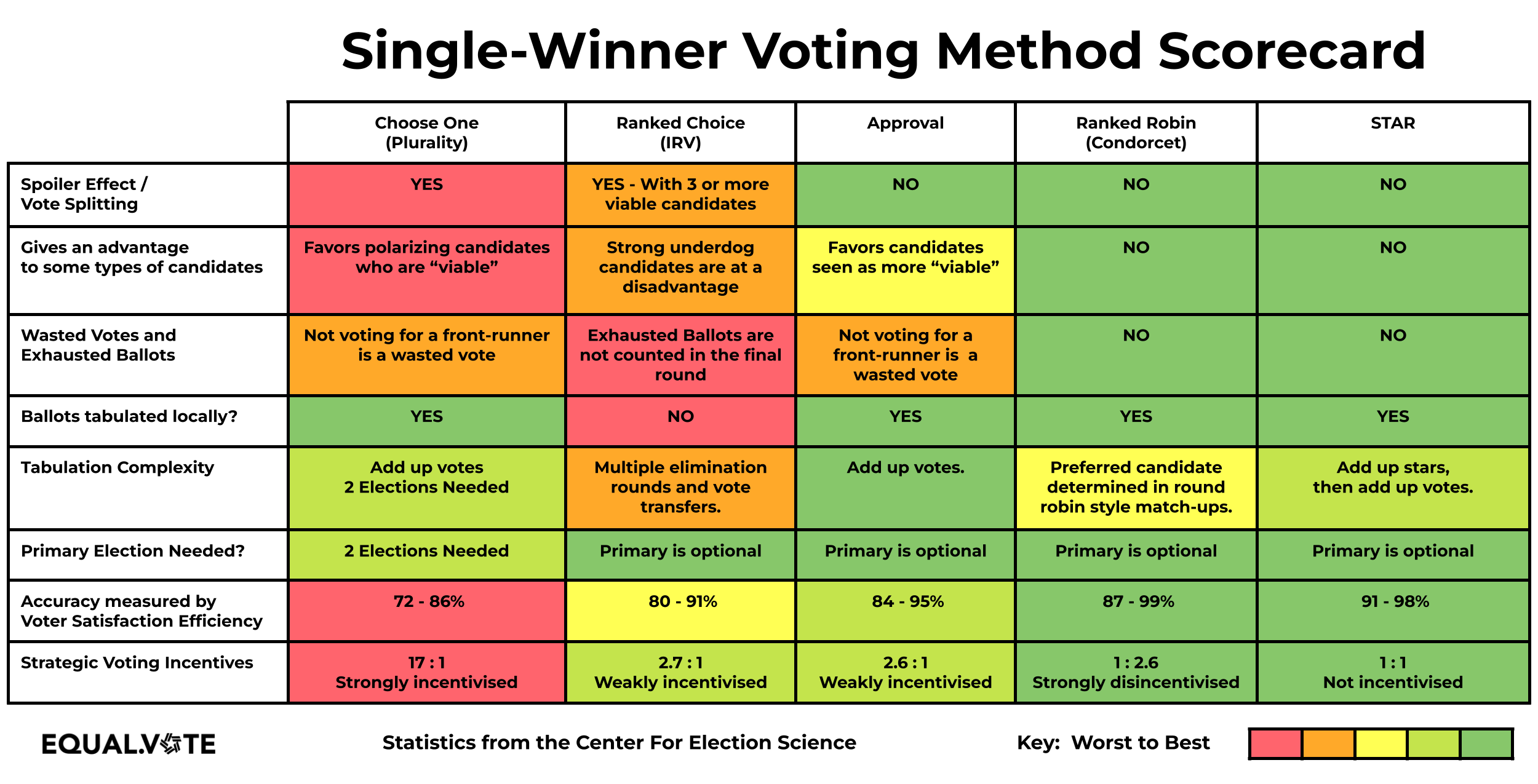
For voters or jurisdictions who are sold on the idea of ranked ballots, we strongly recommend Ranked Robin. Ranked Robin is a top-tier method for tallying ranked ballots that empowers voters to vote their conscience, doesn't waste votes, and delivers highly accurate, representative results.
Try Ranked Robin:
You can host your own elections using Ranked Robin with the BetterVoting.com web app.
The original ranked voting method:
Ranked Robin is a modern name for one of the oldest voting methods out there. First described in the literature in 1299, it was reinvented in the 1780s by Nicholas de Condorcet. Originally named "Condorcet Voting" after its inventor, the method and its variations have gone by many names since. In election science circles, “Condorcet” has become synonymous with voting method accuracy (for ranked methods especially) and the body of scientific literature on the subject has only grown and confirmed the findings of early researchers.
Voting:
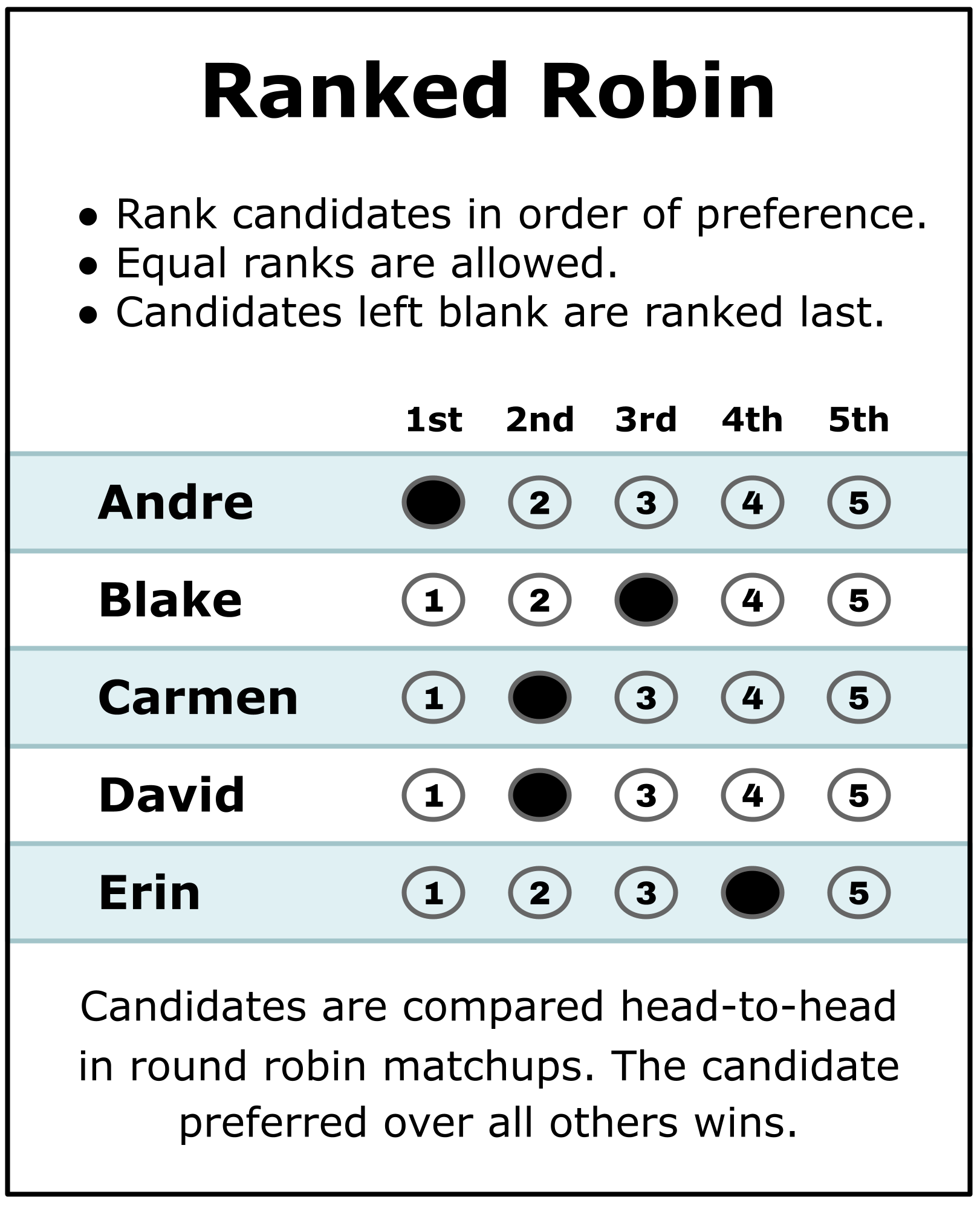
In Ranked Robin, voters rank candidates in order of preference. Voters may rank candidates equally if desired and candidates left blank are ranked last.
Tally:
Ranked Robin compares candidates in head-to-head match-ups. A candidate wins a match-up if a majority of voters with a preference ranked them higher than their opponent. The candidate preferred over all others is elected the winner.

Carmen won the most match-ups against other candidates, so she is elected the winner.
Ranked Robin Advantages:
- Simple. Ranked Robin allows voters to rank candidates however they like. All rankings are counted, and the candidate preferred over the most others wins. This makes Ranked Robin easy for voters and easy to understand conceptually. The fact that all rankings are always counted makes it relatively easy to tally and audit.
- Expressive. Allowing voters to give equal rankings helps voters express more nuanced opinions and ensures voters can rank as many candidates as desired, even if there are more candidates than available ranks on the ballot.
- Honest. Candidates are compared head-to-head, like an election with only two candidates. Voting honestly is always the best choice in that scenario, so voters can rest assured that it’s best to rank candidates honestly.
- Accurate. Ranked Robin always elect the most preferred candidate if one exists. This is the gold standard for measuring accuracy for ranked elections. Peer review and other studies consistently back up claims by advocates. Despite its relative simplicity, Ranked Robin’s accuracy is top tier, especially when paired with a robust tiebreaker.
- Equal. Ranked Robin eliminates vote-splitting and ensures an equally powerful vote for each and every voter by allowing voters to rank candidates freely and then counting all voters' rankings. There are no wasted votes, and whether or not your favorite can win, your vote will make a difference.
- Secure. Ranked Robin ballots can be tallied locally as they come in and ballots are batch summable. This is a vital component of election security, auditability, and election integrity especially in jurisdictions that run geographically-spread or high-profile elections.
- No primary needed. Ranked Robin is highly accurate even in races with a large number of candidates, which means that it can be used without a primary election if desired. This can save taxpayers, candidates, and voters the headaches and expense that comes with holding two separate elections each cycle.
Ranked Robin Disadvantages:
- A ranked ballot doesn't allow voters to express their level of support; a 2nd choice ranking could be almost as good as a voter’s favorite or almost as bad as their last choice. This also makes it less straightforward to look at the election results and see how much support a candidate had overall compared to more granular methods like STAR Voting.
- While the concept of electing the candidate who was preferred over all others is quite simple, the process requires tallying each match-up separately, which can be a lot if there are larger fields of candidates. A five candidate race will require 10 matches. A 10 candidate race will require 45 matches. Still, this is much simpler to tally than Ranked Choice Voting because all rankings are always counted and no ballot data is ignored. Advances in vote tabulation make Ranked Robin viable for scaled competitive elections.
- Because of the way "votes" are often legally defined, Ranked Robin (and Ranked Choice Voting) are less likely to be compatible with existing election law than methods like STAR Voting where each voter's vote ultimately goes to one candidate and the candidate with the most votes wins.
- Despite its popularity in academia and some political spheres, Ranked Robin historically hasn't had much traction toward adoption for US elections. That may be changing, but the main barrier, in our opinion, is the lack of consensus around branding and marketing, which tie-breaking protocols are best, the framing of each tiebreaker as a separate method, and analysis paralysis from comparing the options.
- Many states constitutions require voting methods where each voter votes for one candidate and the candidate with the most votes wins. Unlike STAR Voting, Ranked Robin just doesn't work that way, so it would require constitutional amendments in many states. In the last decade, many other states have banned ranked voting. While these bans are all intended to block Ranked Choice Voting, a few are more broad and also ban Ranked Robin.
- Because most people don't know how Ranked Choice Voting (which we don't support) is counted, and because Ranked Choice is so much better funded and well known than Ranked Robin, we are concerned that support for Ranked Robin could accidentally help get Ranked Choice passed instead.
No voting method is perfect and every possible voting method comes with pros and cons to weigh. After a full deep-dive, the Equal Vote Coalition has determined that Ranked Robin is as good as it gets for a ranked method, and we endorse it wholeheartedly over "Choose-One" Plurality and Ranked Choice Voting.
On ties:
In the event of a rock-paper-scissors tie where there isn't a single candidate preferred over all others, there are a number of logical tiebreaker options supported by the Equal Vote Coalition. A jurisdiction could simply break the tie in favor of the tied candidate who won the most match-ups (Copeland Tiebreaker), or elect the tied candidate who was top-ranked on the most ballots (Favorite Tiebreaker), or elect the tied candidate who lost their worst match by the smallest margin (Smith-Minimax Tiebreaker). The key is to pick something practical and transparent in advance and stick with it.
Ranked Robin refers to any election where the candidate preferred over all others will win, regardless of the tiebreaker chosen.
The case for Ranked Robin:
Ranked Robin is ranked voting with a focus on keeping it simple and transparent for the general public and keeping it practical for real world elections. Now, with growing evidence of the many issues with Ranked Choice Voting there is a renewed need for a ranked method that comprehensively addresses these concerns and can produce the great results voters demand.
Ranked Robin is a viable upgrade that Ranked Choice Voting advocates can adopt without dramatically altering their pitch. Ranked Robin confidently delivers on the many claims often falsely made about Ranked Choice Voting while sticking with the familiar ranked ballot.
Learn more about the issues with Ranked Choice Voting here.